Only 40% of all mothers receive skilled assistance during labor and delivery [
WHO]. Medical Teams International is providing a portable ultrasound for the N’Torosso health clinic in Mali so staff will be able to identify complicated pregnancies and intervene as necessary.
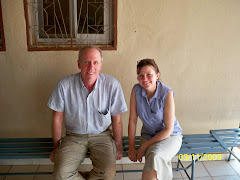
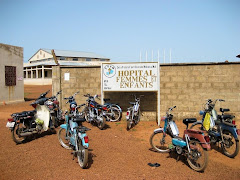
Case study: Minata sits outside the Koutiala Hospital before undergoing surgery for an ectopic pregnancy.
After several blood transfusions—many from his own staff—and hours of surgical repair, the surgeon packed 50 meters of gauze inside Minata's abdominal area and closed her up for the night. A baby had begun to grow outside the mother’s womb, causing severe internal bleeding. The next day, hospital staff gathered in prayer and song, in hope that the bleeding would stop.
The hours following would be critical to her survival.
New ultrasound machine detects problem with pregnancy.When Minata arrived at
Koutiala Hospital in Mali with severe cramping and internal bleeding, surgeons used a new ultrasound machine provided by Medical Teams International. They determined that she had an
ectopic pregnancy—a baby growing outside the uterus.
Dr. Dan Nesselroade, the hospital’s lead surgeon, and four other resident surgeons began operating immediately. Nearly a day and seven blood transfusions later, including a transfusion from Medical Teams International volunteer Dr. William Marks, Minata emerged from her ordeal. "Just a few days later I watched her walk out of the hospital," says Dr. Marks, who says these types of emergencies are quite rare and has seen only one case in his 30-year medical career. "Having access to ultrasound will allow earlier and more accurate diagnoses of ectopic pregnancies," he says.
Making a lifesaving diagnosis in the most remote clinics, Dr. Marks trains the physicians at Koutiala Hospital to use the portable ultrasound machine. Dr. Marks works as a radiologist in Seattle, Washington, and recently took a month off to volunteer with Medical Teams International in southern Mali. He spent his time training hospital staff to use a portable ultrasound machine the size of a laptop computer. Medical Teams International purchased the refurbished machine from
SonoSite, using funds from generous donors.
"The system is generations better than the equipment they had at the hospital," says Dr. Marks.
Thousands of Malian women and babies die of obstetric-related causes every year. “It is hard to get the statistics,” says Dr. Marks, but women who do encounter complications during their pregnancy often cannot reach care before they bleed to death.
Access to an ultrasound during the third trimester will help the N’Torosso clinic staff diagnose problematic pregnancies and refer the patients to larger hospitals equipped to manage their complications. Conversely, a proper diagnosis at the clinic-level ensures that patients will not have to spend a month’s wages or more to travel to the capital for a diagnosis.
"I saw one newborn with a soft spot on his head and the staff wanted to refer him to the capital, more than five hours away, because they thought he had hydrocephalus," Dr. Marks says. "I performed an ultrasound and didn’t find a hydrocephalus, but normal cranial anatomy. The ultrasound ultimately saved the family days of travel time; and in their estimation, the equivalent of three month’s wages."
 In addition to performing more than 140 ultrasounds on patients and providing training for the hospital staff on the use of the machine itself, Dr. Marks also held 10 lectures for the physicians and surgical residents. He covered ultrasound topics ranging from basic physics and obstetrics to fetal malformations, to breast, neck and hernia diagnosis, and liver, gallbladder and renal scanning.