Wednesday, March 18, 2009

Bogolon Fini

Bogolon fini is their mudcloth, in Bambara. We had the most interesting visit at the factory in Segou. The cloth is made of their own cotton (grown in Mali), and dyed (Basilon cloth) with pigments from local leaves or bark. The colors are rich and fascinating - ranging from ochre to mustard to indigo and anything inbetween.


We had the opportunity to make our own mudcloth designs. This is done by painting 'mud' onto the cotton fabric. The mud dyes the area black, so all kinds of shapes and messages are communicated in these cloths.
Tres jolie!

Back in the US

Hello again... well that was an adventure getting back. It was a long but interesting drive back to Bamako. Olive (nurse who's been in Mali for 30 years - speaks Bambara and French fluently... and started out in the villages) shared her stories and answered all our questions. We just couldn't stump her!

I'll share the mudcloth visit in my next blog.

Bill and I thought things were going well when we checked our luggage in downtown, prior to 5pm... only then to find out our 11:45pm flight was delayed, then cancelled. Turned out to be a mechanical issue and a part needed to be flown in the next day. So we had another full day in Bamako. We had a quiet/relaxing day with Keith and Olive taking good care of us. Further delays finally got us out by 3am. Bill and I raced to our connecting flight in Paris and were literally the last folks on. We were so thankful to be on that flight. Bill worked the next day.

We're back and trying to adjust to this time and weather - can you say jetlag supreme!

Thursday, March 12, 2009

Graduation Day

We wrapped up the training today, and we're very pleased with our students and the assessment of their skills. They're sharp! We have been so impressed with how far they have progressed over the couple of weeks. I certainly saw a marked improvement just today... with a few 'aha' moments. We presented them with their 'Certificates' and packed their ultrasound systems and battery packs for their village. They're all set to go!

It's a little overwhelming for us - Bill and I were honored in prayers this morning and also with a gift from them - the traditional Malian mud cloth - very beautiful handcrafted cloth. From our perspective, we are so blessed by this opportunity and really receive more than we give. We come to teach, yet we learn so much.

Bill started into this program about 10 years ago - really believing ultrasound can make a difference in low-resource countries. This is his 6th trip to Africa - and he's seeing this vision come to fruition, and impacting so many lives. As for me, I've been so thrilled to be part of this team. Stay tuned for the Basic Ultrasound Manual (with emphasis on OB) Bill is spearheading - we've made lots of progress on this manual during our time here. This resource is needed in this area and will help others learn and adopt ultrasound into their clinical practice. As Dr.Pierre (Bill's first student in Mali, 1.5 years ago) said, he doesn't know what he would do without ultrasound now... and is continually wanting to learn more.

So, the Medical Team is also wrapping up our time here. I believe we're all leaving Mali fully enriched with this experience. As Dr. Dan says to his patient's "Courage", with his hands up in victory... the team does as well.
Signing off, until home...

Wednesday, March 11, 2009

Blood, Sweat, Tears

Remember me saying anything can happen?... and that this team is adaptable, flexible and willing. Well... they came through yet again today. A patient was in real trouble (I'll spare the details) and needed emergency blood. Well... the hospital doesn't have any means to store blood (no blood bank), so any moving person is game. The visitors (us) are the first to be asked to give blood... that's because the staff give blood so often and can only give about every 3 months (time for replenishment of red blood cells). Paula was first in line as she had the right blood type. So after cross-matching, she donated... and then later Jeanie did, too. And they both received their jelly bean treats! That's how it works. If the patient doesn't do well through the night or tomorrow, Bill and I will be donating too. And for those of you asking... but they're on malaria meds.... it doesn't matter, because most people have had malaria here. This is the blood part.

The sweat part... did I mention it was 38degC today? That's 100degF for our American friends. Today was a bit more humid and since it really didn't cool too much through the night... it was balmy. This was OK... except all utilities become suspect. The hospital ran out of water today (several taps were dry)... not a good thing for sanitation/cleaning and staying hydrated. Fortunately, we found enough to hydrate. Whewh! We also intermittently lose power at the Guest House.

The tears... are tears of joy... for all the lovely babies born each day. What a blessing.

The Hospital

Peter has asked... 'how many beds in the hospital?' I'm not quite sure, but guessed they accommodate around 50 beds. The hospital is going though an expansion right now. Everyday we see progress on the new building. The plan is for 3 more building to make space for more patients/beds and rooms for specific functions (offices/mtg rooms/storage). But, today, this is the setup of the beds. Note they are all lined up, in overflow into the hallways. This is the post surgery recovery area. The NICU and Peds are each a small room, as is the OB recovery (mom's will deliver one day and be released the next). The beds are arranged side-by-side, with no curtains in-between, or any privacy. There are no sheets provided - patients bring their own and will do laundry at the hospital. You see very few men around (the fathers). The expansion plan for the hospital will include 70 beds.

We were treated to an African dinner last evening - yummy! We've seen them eat this in the cantina (and often scooped with right hand - no spoons). It's rice, topped with a sauce. The 'sauce' is meat/fish in a peanut type sauce - very delicious! We had chicken. The missionaries who had us over, Craig and Marilyn, had spent 25 years in the Ivory Coast. They've been here in Koutiala for a year. Craig is the Administrator for the hospital. It's alway fascinating to hear the stories of collaboration of this Christian hospital, within a Muslim community (and country) and the local Christians. (you must be Christian to work at this hospital).

Monday, March 9, 2009

Do Pigs Have Patellas?

You may be wondering... has she lost it? What about the pig? It's one of many conversations and debates of our team. Well, this evening, Paula outdid herself. She roasted a leg of pork for us with all the trimmings (corn, mashed potatoes and choc chip cookies!). And true to form for medical folks, the conversation turned to an anatomy lesson, thanks to Bill - 'here's the pelvic bone, femur, tibia'... 'is there a knee cap?' .... 'I don't know if pigs have patellas'. This will remain a mystery.

Another topic of discussion was related to whether people are happy here. In particular, we were curious about the women, given their position (or lack thereof) in society. They do live a difficult life and are very hard working. On one side, it is argued that they are happy, because this is the only lifestyle they know and know where they stand and are generally content. On the other hand, we have witnessed a sadness in some. It's things like: they can't make decisions without their husband. For example, in order to have a Cesarean section, the husband must give permission (unless it's an emergency). And when they marry, the women leaves her family to live with his family. After some time, he may bring another wife home. So then, all the wives live together. Some men leave for 2 to 3 years (work in Bamako) and the women are left to support the family. Oh.. the stories go on.

It was quieter at the hospital today, due to the holiday, but we made good use of the time in lectures and moving on to the abdominal ultrasound exam. And instead of line drawings, we simply employed Google to bring up all kinds of ultrasound images and illustrations. Thanks to the wireless connection at the hospital, this was a great tool! They are so thrilled to be able search for any pathology to learn what it looks like. Bill would ask, and we would view hydronephrosis, kidney stones, gallstones, cholecystitis, breast masses. And they really 'get it'. C'est bon!

Just love these kids!

Sunday, March 8, 2009

Sunday

A quieter, restful day today... very hot. While I hear it's 38degF at home, it was 38degC here - very Hot!


Walked to the market again.

Saturday, March 7, 2009

The Market and Kids

It was another great day in Koutiala. Paula and I explored the streets and market of downtown Koutiala. It was bustling with activity. The covered market was a maze of multiple vendors selling everything from cookware to fabrics (including tailoring), to shoes and produce. To escape the hustle and activity, we headed across the main street (one of 2 paved roads in Koutiala) toward the neighborhoods. The families live in what looksAdd Image like a compound and could house many generations and families, along with the cows, goats and chickens. There appear to be individual family rooms. This courtyard is typically gated and fenced with mud walls.

We had a lovely experience when we headed down a street where we saw some kids - gotta get pictures, you know. Upon asking if we can take photos, kids came out of the woodwork... all screaming to have their pictures taken. They love to see themselves in pics. Needless to say, we got some great ones. We got invited into the family homestead... and the kids were relentless in wanting their photos taken. So cute.

We also drove out to Pesabe to see the mud temple. This temple is of the same mud construction as the one in Djenne, which is famous. It was interesting, and here again, kids came from everywhere wanting their photo taken... and anything else we had. Any bonbons? The kids are fascinated with Jeanie, and her blonde hair.

We also took a walk around our neighborhood and found ourselves on a path through the field, across a dry creek and into a mango grove. It was beautiful and very quiet - a nice reprieve from the noise and activity of the city. We also came across a soccer field (dry and dusty dirt) where a team of older kids (U21+?) were practicing - running and doing drills. Two things Malians are passionate about - soccer and the elections.

Paula was off the hook this evening, as we were again invited out for dinner to the guesthouse managers home (Bob and Becky - missionaries) - very nice!

The Culture

I had to share this excerpt from Jeannie's (neonatal nurse) blog, since she captures the culture so well. Enjoy!

"Life is sure different here. I spend most of my days hanging out in the delivery room, watching woman after woman go through labor and give birth. Here are some of my observations:

Most of the women here have been circumsized, which leads to extra pain and birth complications. The women here are expected to be stoic and not cry when they are in pain and most of them accomplish this silent birth. Of course an epidural or even an occasional pain med is out of the question. The mothers ( the fathers are no where in sight) do not seem very happy when they first see their baby. I have been told that is because so many of them die and they are afraid to get attached. But after a day or two the attachment is there. In the non-complicated births, the mother will stay one day sleeping on a stretcher with her baby at her side and be discharged the next day. If the baby needs to be observed or treated, he will stay in a bassinette or home-made incubator next to the mother's stretcher until the baby is well enough to go home. The mothers do all the care except for IVs and medicines.

Babies do not wear diapers. The cost is $1/day. Another $2 if the baby needs oxygen. The baby will not be released until the bill is paid. When a baby dies, as many of them do, the mother is not supposed to cry. I witnessed 4 nurses yell at a grandmother start to cry as she watched us being unsuccessful in resussitating her baby. She stopped crying immediately, because that was what was expected of her. I snuck a hug to her when no one else was looking. It must sound to you as if I do not like these people, and that can not be farther from the truth. They work hard, with very little rewards, they make the most of their life with what little is offered, and they have welcomed us with open arms."

Friday, March 6, 2009

Flexibility is Key

Anything can happen and we continue to remain adaptable. We just found out that Monday is a National holiday - to celebrate Mohammed's birthday. Most of our patients are Muslim, so the clinics will not be open. So... plan B... Monday will be more lecture rich and we'll do general abdominal work. So, today we scanned OB patients ALL day... we must have had done 30 - 40 patients. The women have been so gracious and patient to wait their turn.

We had anticipated completing the training next Friday and since we need to travel that day (earlier than expected), we have lost that day. We're adapting to assure our trainees receive the training they need. They are doing very well, so we are confident they will be ready to put their skills to use in their clinics.

So, it's Friday. Already one week. Yikes, I wish it could slow down - this has been so great.

And the weekend is upon us - while some will go into the hospital Sat morn, Paula & I will go in to town to explore. I'm interested in the fabrics (ala table cloths), Malian mud cloth (dyed with their red/brown soil, dark bark and bleach in fabulous patterns) and wandering through the market. We may also get to an old mud constructed temple.

Thursday, March 5, 2009

Thursday in Koutiala

We had yet another fullfilling day at the hospital. We scanned several patients in the morning with our students. They are progressing so well. Some challenges were thrown their way as some pathology cases presented. It kept us alert, too. And, as usual, Bill delivered a stellar lecture in the afternoon.

Hot facts: 38 babies have been born so far this month. And it's the 5th! The women have multiple (up to 8 pregnancies) during their lifetime. In general, one out of four children will live past 2 years. Culturally, women may take several days to bond with their newborns, as neonatal mortality is so high post delivery.
It's a quiet evening for us. Paula cooked a great meal and we're taking some time out.

Wednesday, March 4, 2009

Day 2 of Training

Wow, another great day at the hospital. We start each day with hands-on scanning with our main students, Abel Kone (Farakala Clinic) and Alleye Coulibaly (Farmarila Clinic). Youssouff Dembele will be joining us for the hands-on portion for a refresher. The other trainees Drs. Pierre, Luther and Yohanna join us in the afternoon for the lectures. They have received training and scan tres bien. Daniel (Dir of Admin) has also joined the group. We're finding more people expressing interest in joining us and learning about this exciting new technology that they have already seen make a difference in the care of their patients. Our new students are very bright, eager to learn, grasping the concepts quickly and studious. They were outside the scanning room with their French Obstetrical Ultrasound book, before we got there in the morning.

We couldn't do all this without Dr. Dan Nesselroade. His passion for ultrasound is contagious. He does spirited translations for us... boy, we wish our French was better! He continues to expand the use of tools to explain some complex ultrasound principles... i.e., baby doll to show fetal position; he used the baby doll's cap to represent the placenta... and even placed the doll within a napsack to represent cephalic presentation. Too funny. We had some laughs today after he asked Marci (his wife) to bring a French loaf of bread (and knife) to explain how ultrasound takes tomographic images... and what we see is only a slice (get it?)... ahhhmmm... a 2D image from a 3-D object (fetus). This concept is complex, but very important to understand - the mind must process/translate what we're seeing. So there was Dan, slicing the bread in the transverse, sagittal, coronal and even oblique planes to demonstrate what is seen in the 'slice'. Wonderful.

Dr. Dan has been instrumental in setting up this program. At the end of this training, 4 clinics and the hospital will offer ultrasound. This will be followed up with up with 2 more clinics when the solar power is configured. This is something for Mali... and could certainly expand... to other countries and this center could be the Center of Excellence for Africa. And while difficult to prove, it has already had an impact on maternal and fetal mortality. What a blessing!

It's market day in Koutiala tomorrow, so we hope to take that in...

Tuesday, March 3, 2009

Amazing First Day

Wow, what a day at the hospital. It started with devotions at 7:30am. It's in French and Bambara, so we were fortunate to have Teri translate for us. The singing was great. Following this, we went on Rounds with the medical team - quite the stories and they are almost at capacity.

For the ultrasound training, we have 2 nurses from the village clinics, very eager to learn. They were amazing in quickly picking up the concepts. In addition, the formerly trained physicians will get a refresher. Dr.Pierre is very good!

The highlight for me today was the opportunity to observe 2 babies being delivered... within a minute of each other. Olive was amazing in managing these events, with her 30 years of experience.

More stories and details tomorrow... now... I hope to catch up on my sleep...

The Long Journey

We've arrived safely in Koutiala, Mali. It's a long way from home. Travels included 9.5 hour flight to Paris, 8 hour layover, 5 hour flight to Bamako. From landing and throughout our time here, the missionaries have been outstanding - so gracious! The organized chaos at the airport was manageable and we were lucky to get ALL our luggage and quickly. We were escorted to the guest house and crashed. The next day was full - breakfast with the local missionaries, change our money, drive to Segou for lunch on Niger river (very beautiful) and then off to Koutiala (total 5 hour drive).

The drive was fascinating - in general it's very dry, red soil, with some areas a little more green. The baobob tree is bare at this time and most fields have been harvested, and dry. Not a lot of 'wildlife', but tons of goats on the roadside... everywhere. They were grazing on the harvested cotton (seed) that would fall on the roads when the cotton is transported for processing. They would move off the road quickly with the sound of the horn. The sheep were just not as bright.

There are several groups of teams at the guest house in Koutiala - an IT group (from Omaha, NE), a warehouse/building team and us, the medical team. Dr.Richard Wong (Ob/Gyn), Jeannie Russ (neonatal nurse), Paula Berry (our cook) and Dr. Marks and me.

We had a lovely celebration and potluck, with 55 people over shortly after we arrived - what fun to meet the missionaries and their families. They are amazing people.

Saturday, February 28, 2009

All set to go!

Bags are packed, malaria pills in hand, yellow fever card, passport/visa and ticket in hand... and we're off. Lots of emotions - excitement, anticipation, nervousness, but overall... feeling very blessed for this opportunity. Thank you to all who called/e-mailed with your well wishes and blessings - we appreciate your prayers!

Thursday, February 26, 2009

Snow....?

Wow! I awoke this morning to 4 inches of snow in my backyard. Yikes, this is the end of Feb... and crocuses are in bloom! But, alas, it will disappear by tomorrow. We're sure looking forward to the balmy temperatures in Mali - pretty steady 95 - 105 deg F ( 35-39 deg C) during the day and 73 deg F (20 deg C) during the night.

Dr.Marks and I visited Sonosite today. They have been fabulous in supporting us in this program and we're (Medical Teams International) grateful for this resource. It was great to see some old colleagues there too. Thanks, Erik, for all your help!

I also picked up a part from Cenorin today, for the pasteurmatic/sterilizer that was donated to the hospital. They are gratefully using the system and I'll be reporting back to Ric how it's all going.

More later...

Wednesday, February 25, 2009

Sonosite 180PLUS

Here's the ultrasound system we are taking with us. Note the size - fits perfectly in the backpack. In total, there will be 6 ultrasound systems - 1 in the main hospital and the others in the five outlying clinics. These are destined for the clinics that have solar power installed. The others will follow. The systems already in place are making a difference! The clinicians are making accurate diagnoses and referring the patients to the main hospital.

They call this program ultrasound "j'adore!".

Monday, February 23, 2009

The road to Koutiala

Here's the 5 hour journey to Koutiala, from the capital, Bamako.

Sunday, February 22, 2009

Where is Mali?

Many have asked me, 'Where exactly is Mali?' Well... have you heard of Timbuktu? It's in Mali, Africa! Of course, Mali is famous for more than Timbuktu. It's also been described as a nation of unusual interest and charm.

The map gives a better idea, but here are the 7 bordering states: Algeria lies to the north and northeast, Niger to the east, Burkina Faso to the southeast and, with the Ivory Coast, to the south. On the west are Senegal and Mauritania. Mali is largest country in West Africa.

We will be in Koutiala which is about a 5 hr drive (275 km) east, from the capital, Bamako.

Friday, February 20, 2009

Lectures complement Hands-on Training

In addition to performing more than 140 ultrasounds on patients and providing training for the hospital staff on the use of the machine itself, Dr. Marks also held 10 lectures for the physicians and surgical residents. He covered ultrasound topics ranging from basic physics and obstetrics to fetal malformations, to breast, neck and hernia diagnosis, and liver, gallbladder and renal scanning.

"While a number of individuals received help, the most important part was the training," says Dr. Marks. "My experience was just great…and it is very cool to see the impact we are having firsthand."

Mothers and children now have access to ultrasound--which can be the difference between life and death for many.

"This successful innovation represents the happy intersection of appropriate technology emerging from the vision of Dr. Marks and his initiative with Sonosite," says Bill Mitchell, director of Africa programs at Medical Teams International. "Moreover, the effective transfer of this proven technology saves lives for the mission in Mali and builds a solid foundation of locally trained and capable primary care clinic and hospital staff. Because of the clear success of this training, we are already planning to expand this program in similarly situated areas of need."

Ultrasound by Solar Power

The ultrasound machine can be powered using conventional electricity, batteries and even solar energy. An electrical engineer helped the team set up solar panels on the roof of one of the hospital’s six outlying health clinics—and the team proceeded to conduct a solar-powered ultrasound on a pregnant woman. This N’Torosso clinic is several miles from any formal power source and has never before had access to a piece of diagnostic equipment.

"We explained to the people that the initial ultrasound was a pilot and that Dr. Pierre Kamate, whom I spent time training, would be back to the clinic with the equipment soon," says Dr. Marks.

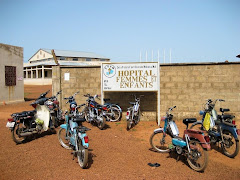
Koutiala Hospital

Only 40% of all mothers receive skilled assistance during labor and delivery [WHO]. Medical Teams International is providing a portable ultrasound for the N’Torosso health clinic in Mali so staff will be able to identify complicated pregnancies and intervene as necessary.

Case study: Minata sits outside the Koutiala Hospital before undergoing surgery for an ectopic pregnancy.

After several blood transfusions—many from his own staff—and hours of surgical repair, the surgeon packed 50 meters of gauze inside Minata's abdominal area and closed her up for the night. A baby had begun to grow outside the mother’s womb, causing severe internal bleeding. The next day, hospital staff gathered in prayer and song, in hope that the bleeding would stop.
The hours following would be critical to her survival.

New ultrasound machine detects problem with pregnancy.
When Minata arrived at Koutiala Hospital in Mali with severe cramping and internal bleeding, surgeons used a new ultrasound machine provided by Medical Teams International. They determined that she had an ectopic pregnancy—a baby growing outside the uterus.

Dr. Dan Nesselroade, the hospital’s lead surgeon, and four other resident surgeons began operating immediately. Nearly a day and seven blood transfusions later, including a transfusion from Medical Teams International volunteer Dr. William Marks, Minata emerged from her ordeal. "Just a few days later I watched her walk out of the hospital," says Dr. Marks, who says these types of emergencies are quite rare and has seen only one case in his 30-year medical career. "Having access to ultrasound will allow earlier and more accurate diagnoses of ectopic pregnancies," he says.

Making a lifesaving diagnosis in the most remote clinics, Dr. Marks trains the physicians at Koutiala Hospital to use the portable ultrasound machine. Dr. Marks works as a radiologist in Seattle, Washington, and recently took a month off to volunteer with Medical Teams International in southern Mali. He spent his time training hospital staff to use a portable ultrasound machine the size of a laptop computer. Medical Teams International purchased the refurbished machine from SonoSite, using funds from generous donors.

"The system is generations better than the equipment they had at the hospital," says Dr. Marks.
Thousands of Malian women and babies die of obstetric-related causes every year. “It is hard to get the statistics,” says Dr. Marks, but women who do encounter complications during their pregnancy often cannot reach care before they bleed to death.

Access to an ultrasound during the third trimester will help the N’Torosso clinic staff diagnose problematic pregnancies and refer the patients to larger hospitals equipped to manage their complications. Conversely, a proper diagnosis at the clinic-level ensures that patients will not have to spend a month’s wages or more to travel to the capital for a diagnosis.

"I saw one newborn with a soft spot on his head and the staff wanted to refer him to the capital, more than five hours away, because they thought he had hydrocephalus," Dr. Marks says. "I performed an ultrasound and didn’t find a hydrocephalus, but normal cranial anatomy. The ultrasound ultimately saved the family days of travel time; and in their estimation, the equivalent of three month’s wages."

Medical Training Team to Mali, Africa; Feb 28 - Mar 13, 2009

The maternal mortality rate in Mali is nearly 73 times higher than the rate in the USA.
Only one in four expecting mothers receives prenatal care or assistance with their delivery, and pregnant mothers often have no help when complications arise. One of the reasons for Mali's high maternal mortality rate is that many women do not know when they are experiencing a complicated pregnancy. The ultrasound technology we take for granted in the United States is simply not available to women in Mali.

Medical Teams International are piloting a rural ultrasound training project with our partner, CPAM, to meet this need. Dr. William Marks and Lydia Zibin will teach clinic physicians and head nurses at six rural health clinics to detect potentially problematic pregnancies using a portable ultrasound machine.

This project aims to reduce maternal and child deaths by 20% in the region where we're working. As the success of this program is established, our work will be used as a model for additional rural ultrasound projects in Mali and other African countries.

Medical Teams International would like to thank SonoSite for generously donating six re-manufactured portable ultrasound machines and accessories. Without their assistance and the generosity fo other donors and volunteers, this project would not be possible.